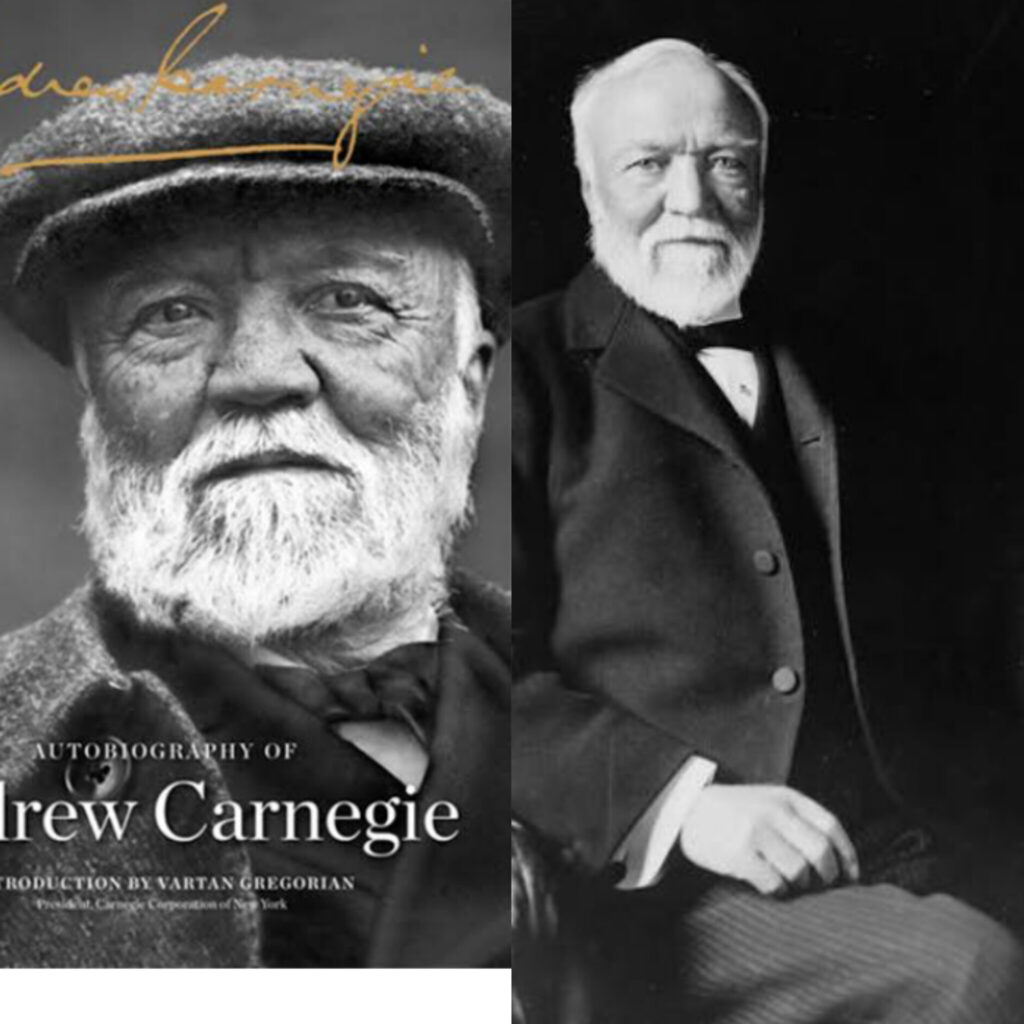

Andrew Carnegie (1835-1919) stands as one of the most remarkable self-made industrialists and philanthropists in American history. Born in Scotland into a working-class family and immigrating to the United States as a teen, he rose from a cotton mill job and telegraph messenger to build a steel empire and become one of the richest men the world has ever known. His story matters because it illustrates not only the power of ambition and innovation during the Industrial Revolution but also the profound impact of giving back: Carnegie transformed his fortune into legacies of libraries, education, and peace institutions.
See also: Bob Dylan Biography: Net Worth, Age, Wife, Education, Family, Career & Early Life
“The man who dies rich dies disgraced,” Carnegie famously wrote — encapsulating his belief that great wealth carries an obligation to society.
In this biography we will explore his early life, scant formal education but enormous self-education, his meteoric career in steel, family life, net worth and enduring legacy.
Highlights Andrew Carnegie Biography
- Full Name: Andrew Carnegie
- Date of Birth: November 25, 1835
- Date of Death: August 11, 1919 (Age 83)
- Profession: Steel industrialist, investor, philanthropist
- Estimated Modern-Day Equivalent Net Worth: Frequently cited at US$300-$310 billion when adjusted for today’s dollars
- Wife: Louise Whitfield (married 1887)
- Children: One daughter, Margaret Carnegie Miller
- Education: Basic schooling in Dunfermline, Scotland; immigrant self-education via libraries and night school in Pennsylvania
- Major Career Milestones: Founded Carnegie Steel Company (circa 1870s), sold to J.P. Morgan in 1901, devoted his later life to philanthropy
- Major Legacy: Funded thousands of public libraries, established educational and peace institutions worldwide
Early Life
Andrew Carnegie was born on November 25, 1835, in Dunfermline, Fife, Scotland, into a modest weaving family. His father, William Carnegie, was a hand-loom weaver and active in Chartist political reform; his mother, Margaret Morrison, came from an equally working-class background. Industrialization disrupted his father’s business, prompting the family to emigrate to the United States in 1848. They settled in Allegheny (now part of Pittsburgh), Pennsylvania.
As a young immigrant, Carnegie took his first job at age 13 as a “bobbin boy” in a cotton mill, earning a meagre wage and long hours. He subsequently worked as a telegraph messenger and operator, seizing every opportunity to learn, read and improve himself. His upbringing instilled in him both humility and hunger — his books were his education, and his ambition propelled him into the booming American industrial age.
Education
Carnegie’s formal education was minimal: his early schooling in Scotland was cut short by emigration; in the United States he attended night classes and benefitted from a local employer-library arrangement that allowed working boys access to books. He famously said that the library “saved his soul.”
Rather than formal degrees, Carnegie’s education was self-driven reading, self-study of business, and on-the-job experience in railroads and industry. He cultivated discipline, curiosity and a continual improvement mindset — traits that underpinned his business success and philanthropic vision.
Career / Professional Journey
Andrew Carnegie’s professional journey is a textbook example of upward mobility and industrial entrepreneurship. He began in the railroad industry, working for the Pennsylvania Railroad Company and investing wisely in sleeping-car companies, oil, iron and locomotives. He recognized early that steel would be central to America’s industrial future.
In the early 1870s he founded the J. Edgar Thomson Steel Works near Pittsburgh, implemented the Bessemer process and, through vertical integration— controlling iron-ore deposits, coke fields, railroads and rolling mills — built the formidable Carnegie Steel Company by the 1880s.
By 1901, Carnegie sold his steel business to financier J.P. Morgan (which became part of U.S. Steel Corporation) for roughly US$303 million at the time. When adjusted for modern dollars, many analysts equate his personal fortune to hundreds of billions. Having achieved his financial goals by middle age, Carnegie turned his energy to large-scale philanthropy — funding more than 2,500 public libraries, creating the Carnegie Institute of Technology (which later merged into Carnegie Mellon University), and establishing enduring foundations for education, science and peace.
Net Worth and Lifestyle
Estimating the net worth of Andrew Carnegie is complex because his wealth came in assets, equity and industry leadership in a different era. Contemporary estimates place his raw sale at about US$303 million in 1901, but when adjusted for GDP share and economic context, his wealth is often cited at roughly US$300-310 billion in today’s terms.
Despite enormous wealth, Carnegie embraced a philosophy of giving. He gave away more than US$350 million before his death, and directed the rest of his fortune into educational and charitable trusts. His lifestyle in later years was that of a public-minded gentleman of means rather than ostentatious extravagance; he lived part-time in New York City and summered in Massachusetts, travelled widely and focused on philanthropy rather than accumulating more wealth.
Personal Life
Andrew Carnegie married Louise Whitfield in 1887 when he was in his early fifties. Louise came from a well-established New York family and the marriage produced one daughter, Margaret Carnegie Miller. Carnegie’s decision to marry later in life reflected his earlier total focus on business. He and Louise maintained residences in New York City and had a Scottish estate (Skibo Castle) and summer home in Lenox, Massachusetts.
Carnegie’s family life was stable though subdued; his daughter Margaret inherited his philanthropic commitments. He had few public scandals, maintained strong family ties and channelled much of his wealth into constructive social initiatives. At his death on August 11, 1919, he left an enduring legacy of giving and institution-building rather than personal dynastic accumulation.
Conclusion
Andrew Carnegie’s life is the archetype of the American “rags-to-riches” narrative fused with a moral conviction about wealth’s responsibility. From Scottish immigrant to steel magnate, and finally to global philanthropist, his journey shows that extraordinary business success can coexist with equally extraordinary generosity. His libraries, schools, institutions and the philosophy captured in The Gospel of Wealth continue to resonate in the 21st century.
His story reminds us that wealth can be a vehicle not just for personal gain but for meaningful social change — and that in the end, legacy often matters more than the ledger.
FAQs About Andrew Carnegie
What was Andrew Carnegie’s net worth?
At the time of his business peak he sold his steel company for about US$303 million in 1901; when adjusted for modern dollars his wealth is often estimated at US$300-310 billion.
How old was Andrew Carnegie when he died?
He died August 11, 1919, at age 83.
What was Andrew Carnegie’s educational background?
He had minimal formal schooling but educated himself via night school, reading widely, and on-the-job experience.
Was Andrew Carnegie married?
Yes, he married Louise Whitfield in 1887; they had one daughter, Margaret.
What were Andrew Carnegie’s most famous business achievements?
He founded the Carnegie Steel Company, dominated the American steel industry via vertical integration, and sold his company to J.P. Morgan in 1901.
What is Andrew Carnegie’s nationality?
He was born in Scotland and became a Scottish-American industrialist after emigrating to the United States.
How did Andrew Carnegie become famous?
He emigrated to America in 1848, began working in railroads and industry, sensed the importance of steel in the industrial age, built Carnegie Steel, amassed enormous wealth and devoted his later life to philanthropy.